
Neighbors Without Borders: Healing through service
By: Jordan Venell
Lizeth Pineda-Roldan was walking through Walmart with her boyfriend shortly after Immigration and Customs Enforcement announced the start of Operation Metro Surge, when she locked eyes with a man shopping for tortillas, arroz and other household essentials.
There was “fear in his eyes,” she said.
As a first-generation American citizen with parents from Mexico, Pineda-Roldan had been anxious about the increased ICE presence sweeping the Twin Cities region. She had already begun using her social circle to raise money for immigrant families in her community. Sympathizing with the man, she saw an opportunity to make a difference.
“What I really want to tell you is that I don’t know what this month is going to look like,” Pineda-Roldan said she told the man. “We know ICE is here. I want to buy what you need at least for the month.”
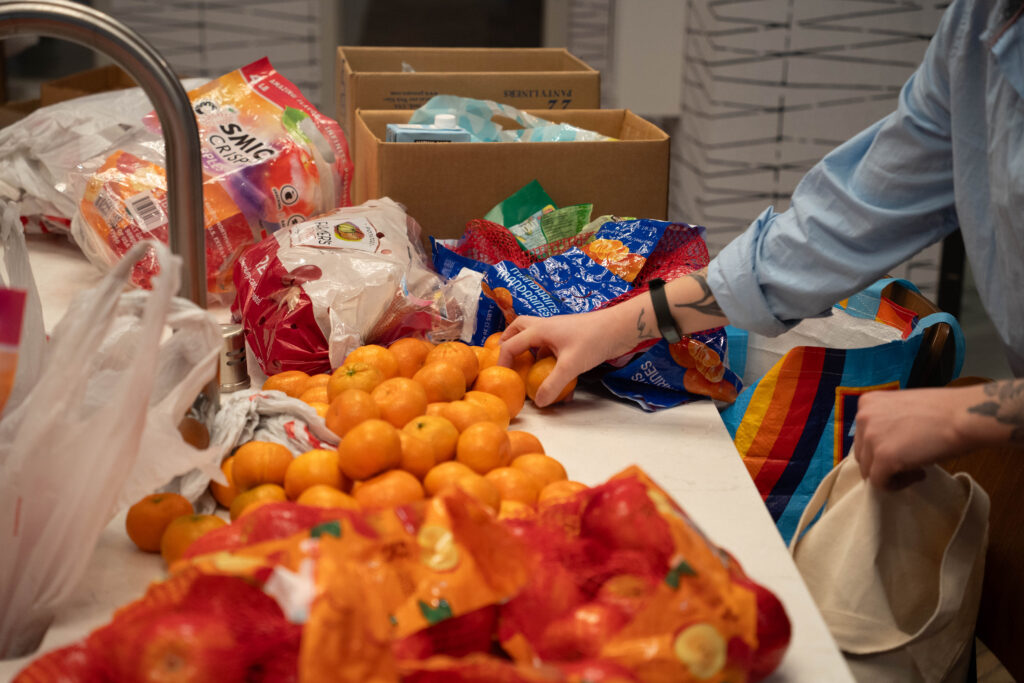
Pineda-Roldan’s effort was one of many in the Twin Cities during Operation Metro Surge. Across the metro area, students, neighbors and local organizations launched initiatives to provide food, resources and support to families affected by the heightened ICE presence.

Within that moment of empathy at a local Walmart, Neighbors Without Borders, a community-based food and household necessity delivery service, began to take shape.
Community support has always been a critical part of Pineda-Roldan’s life. Growing up she explained she was raised by her parents alongside her neighbors and the broader Minneapolis community. Witnessing the fear Operation Metro Surge incited in her community, she began thinking about what she could do to help.
Pineda-Roldan decided to send her Venmo code to her friends, many of whom she met in the Institute of Women’s Leadership at the College of Saint Benedict. She was requesting money to support immigrants in her community any way she could. Within days she raised around $600.
Although the donations and support were encouraging, ineda-Roldan knew she would need help to make a sizable impact on the lives of immigrant families throughout the Twin Cities.
“We can’t do it all alone,” she said. “We do things better in community.”
Soon after, Pineda-Roldan received a text from Alondra Rojas-Duarte, a friend who had seen the work she had been doing and wanted to help. Together, they began working towards what would become Neighbors Without Borders.
That weekend, Pineda-Roldan was leaving Sam’s Club after buying groceries when she encountered ICE agents patrolling.

“They were just creating fear, they were driving around the parking lot with their tinted windows and their lights on,” she said.
Although unsettling, witnessing ICE agents patrolling a grocery store illustrated the importance of the work they were doing. Simply shopping for household necessities had become a serious risk for immigrant families in the Twin Cities metro area.
“We were seeing a bigger need week-by-week,” Pineda-Roldan said. “The parents were literally having mental health crises.”
Soon after, Pineda-Roldan received a text from Alondra Rojas-Duarte, a friend who had seen the work she had been doing and wanted to help. Together, they began working towards what would become Neighbors Without Borders.
That weekend, Pineda-Roldan was leaving Sam’s Club after buying groceries when she encountered ICE agents patrolling.
Venmo donations began to increase as well, extending well past their immediate social circles, as more people heard about the work they were doing.
“Our Venmo had reached people from Chicago,” Pineda-Roldan said. “We received some support from Hawaii too. It’s crazy.”
What began as deliveries for a few families expanded to support a total of 82 families and 111 teenagers and kids, according to the Neighbors Without Border’s Instagram page.
With NWB growing and becoming an organized community food delivery service, Pineda-Roldan and Rojas-Duarte began thinking much more about the safety of themselves, their volunteers and the vulnerable families they support.
Drivers were told to keep messages simple when coordinating deliveries, avoiding any language that would give away what they were doing.
“Drivers don’t say we’re delivering food. It’s just, ‘I’m outside’ or ‘I’m on my way in 15 minutes’,” Pineda-Roldan said.
All information relating to deliveries and the families NWB supported was written on paper and shredded after deliveries were carried out. Pineda-Roldan and Rojas-Duarte explained they avoided using full names, instead recording only a first name and last initial.
They said they were deeply aware of the trust families placed in NWB and worked to ensure it was never misplaced.
During such unprecedented and anxious times, Pineda-Roldan and Rojas-Duarte often found themselves discouraged.
“There’s been moments that have brought lots of sadness and confusion,” Rojas-Duarte said. “Like, what does the future look like for me? What does the future look like for my family? What does it look like for my friends?”
Yet, throughout their work organizing and leading NWB, they found solace in activism and the impact they were making on their community.
“It was my only way of coping through all of it,” Pineda-Roldan said. “I could not sit on my couch. I was barely getting any sleep because I was just constantly thinking of the what-ifs with my parents.”
For Rojas-Duarte, Neighbors Without Borders became a reminder that even in difficult moments, people still show up to support one another. Yet, for all the community support, both Rojas-Duarte and Pineda-Roldan recognize that there is still plenty of work to be done.
“Sometimes in this darkness you don’t really see that people care, you start wondering, do people really care? And they do,” Rojas-Duarte said. “Unfortunately, there’s a lot who don’t.”
Together, Rojas-Duarte and Pineda-Roldan hope their efforts will encourage others to use their voice and actions to protect their communities. From its name to its mission, NWB reflects what they see as a template for local change.
“Love and resistance go hand in hand,” Rojas-Duarte said.
For Rojas-Duarte resistance takes form through community-driven works, voicing concerns and holding politicians accountable when meaningful change isn’t implemented. Even when progress feels slow.
Despite the community’s support and positive impact of their work, the future for NWB is uncertain. Now that Operation Metro Surge has concluded, they have received less and less financial support, forcing them to limit the amount of families they delivered to during their most recent donation event on March 8.
“We are very low on funds and donations,” Pineda-Roldan said. “This weekend we will only be able to serve 30 out of the 86 families we’ve been serving.”
Even with reduced operations, NWB continues to serve a vital purpose.
“The page is a reminder of what I think is so crucial for all of us, which is hope,” Pineda-Roldan said.
Through their work, Rojas-Duarte and Pineda-Roldan reinstilled hope not only within their communities but within themselves as well. Pineda-Roldan often returns to a quote that captures that feeling of resilience.
“Our body is not a coffin for pain,” she said.