
Students versus the U
Two student protesters and their fight against Operation Metro Surge on the University of Minnesota campus.
By: Isabella Morden Wheeldon
Crow Wilkins has a message for University of Minnesota students on the sidelines as federal immigration agents surged through the Twin Cities.
“Your neighbor’s lives and your lives have become a political tool,” Wilkins said. “You don’t really have a choice whether to become politically involved, because they’re forcing you to be.”
For decades, the University has served as an epicenter of youth activism, and Wilkins, a third-year animal science student, is in a long line of students who have organized resistance to policies.
Activism stretches back to the University’s first Vietnam War protest in 1965 and the “Morrill Hall takeover” by Black students a few years later. It spiked again in 2024 with the brilliant sea of camping tents that flooded the lawn between Northrop Memorial Auditorium and Coffman Memorial Union. For nearly 10 days, the UMN Divest encampment occupied grounds in the spring of 2024 to resist the University’s ties with Israeli companies.

This time around, Wilkins stood at Morrill Hall in early February to protest ICE activity on campus. Even after the release of the four students who chained themselves to the administrative building’s doors, Wilkins called the university’s response pathetic.
“The university keeps sending out these really vaguely worded emails about how community is important and we’re working to keep everyone safe, but there hasn’t been a single policy change,” Wilkins said. “There hasn’t been a definitive statement. There hasn’t been anything that actually helps the students.”
So, some students took matters into their own hands. The tactic of choice? Noise demonstrations at the Graduate Hotel, part of a chain owned by Hilton, adjacent to the university campus.
Emma Daugherty-Leiter is a first-year English major and member of the Students for a Democratic Society.
Daugherty-Leiter hit the ground running when she saw traces of Operation Metro Surge breach university grounds in winter, joining hundreds at the Graduate Hotel when SDS caught wind that ICE agents were staying there.
Looking back, Daugherty- Leiter saw the demonstrations as effective, largely in part due to their calculated hit on the hotel’s finances.
“Seeing businesses that house ICE and shelter ICE basically go into a nosedive like that is always pretty good to see because it punishes them where it matters for them,” Daugherty-Leiter said. “These business interests, they only speak one language, and that language is money.”
At a Feb.13, 2026 Board of Regents meeting, Daugherty-Leiter and a cohort of SDS members packed the room to confront the university’s leaders head-on, because the meeting framework holds no time for a public comment period. The group’s outstanding charges from previous protests, like the ones at the Graduate, led them to choose caution and vacate the meeting before authorities took legal action.
After the meeting, Daugherty-Leiter reflected on the efforts against those in charge.
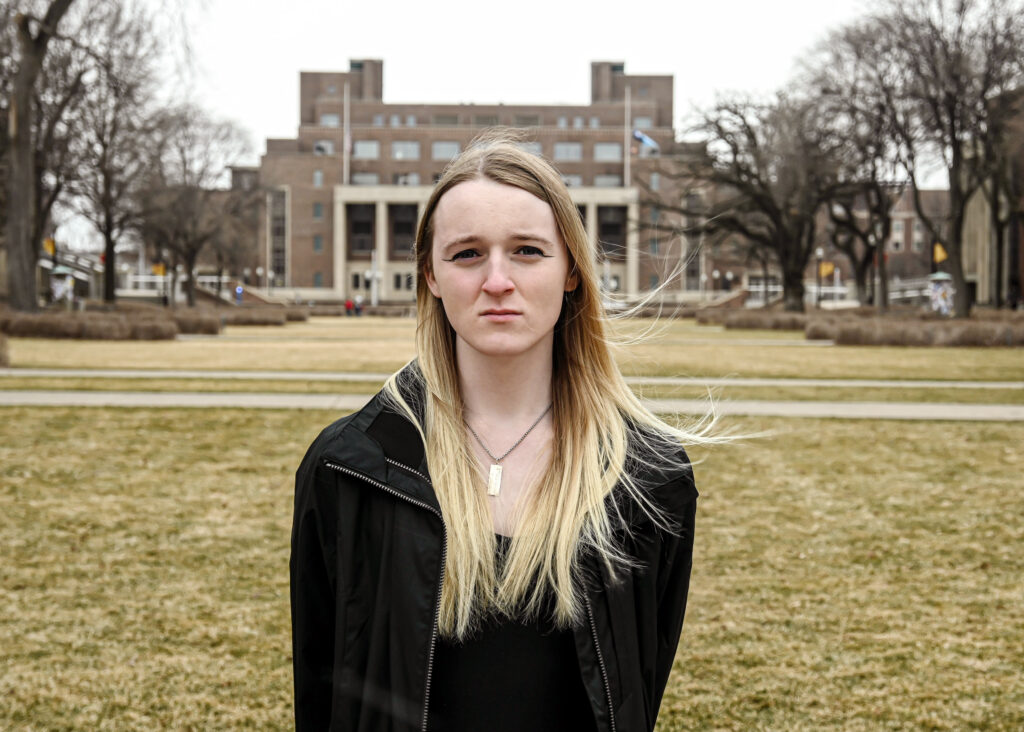
“When it comes down to it, the Board of Regents, the people up top, have not been helping us,” Daugherty-Leiter said. “You can see that those people are not going to save you. It’s your friends, your family, it’s your neighbors that are going to save you, it’s the students around you, it’s the faculty that are working together. Those people in high places have not made steps to save us.”
Daugherty-Leiter’s activism didn’t stop at university grounds. The Henry Bishop Whipple building is a conglomerate of federal offices now turned detention center located at Fort Snelling. Though Democratic officials publicly condemned Operation Metro Surge, entities like the Hennepin County Sheriff’s Office teamed up with ICE at the Whipple building.
“If you’re actually on the ground there, you see that a lot of these state agencies have actually been carrying a lot of water for ICE,” Daugherty-Leiter said. “Hennepin County sheriff in particular has been running a lot of security at the Whipple, and if anyone steps out of line, even if you don’t step out of line there, they’ve charged the crowd on occasion and attacked people and arrested them for no reason whatsoever.”
Wilkins was skeptical of bystanders as tensions spiked after ICE agents killed both Renee Good and Alex Pretti.There were other ways to pitch in than standing on the front lines, Wilkins said. Nothing requires you to put yourself in danger.
“Every movement has different aspects. If you don’t want to go face-to-face with the cops, why don’t you help bring people you love groceries? Why don’t you put up flyers? Why don’t you check in on your friends and make sure they’re okay when they’re walking home from school, you know?” Wilkins asked. “There’s really no excuse to not get involved besides the privilege of ignoring problems that you think aren’t yours yet.”
Wilkins’ philosophy behind helping out isn’t complex. In fact, what drives their motivation to advocate is one of the most fundamental human capabilities of emotion.
“I was taught that you have to love people. Those morals I learned as a kid, I guess, never left me,” WIlkins said. “When I see people complaining about illegal immigration, it’s like, ‘how did America get here? You came here and slaughtered indigenous people and took the rest as slaves to make them build your empire.’ I just can’t sit aside.”