
Small businesses step up for community, but at what cost?
Business owners reel from the financial and emotional strain caused by Operation Metro Surge
By: Ava Grace
The feeling was all too familiar. The smell of tear gas lingering in the air, sounds of chanting echoed from corners and makeshift memorial sites honoring Minneapolis residents killed by law enforcement. But this time was different.
When a police officer murdered George Floyd in May 2020, Minneapolis residents acknowledged that one of the consequences of their rage was damage to local businesses. They hoped government COVID-19 relief funds would help restore the newly empty lots standing on Lake Street.
But this time, when federal agents launched Operation Metro Surge, which they proclaimed the “largest immigration enforcement operation ever carried out,” it was clear that business and community members would have to rely on each other.
And so, the idea of “mutual aid” rapidly took root and built around businesses as community centers. They became sources for food and other necessities, and distributing or raising money to help protect their neighbors from aggressive federal agents.
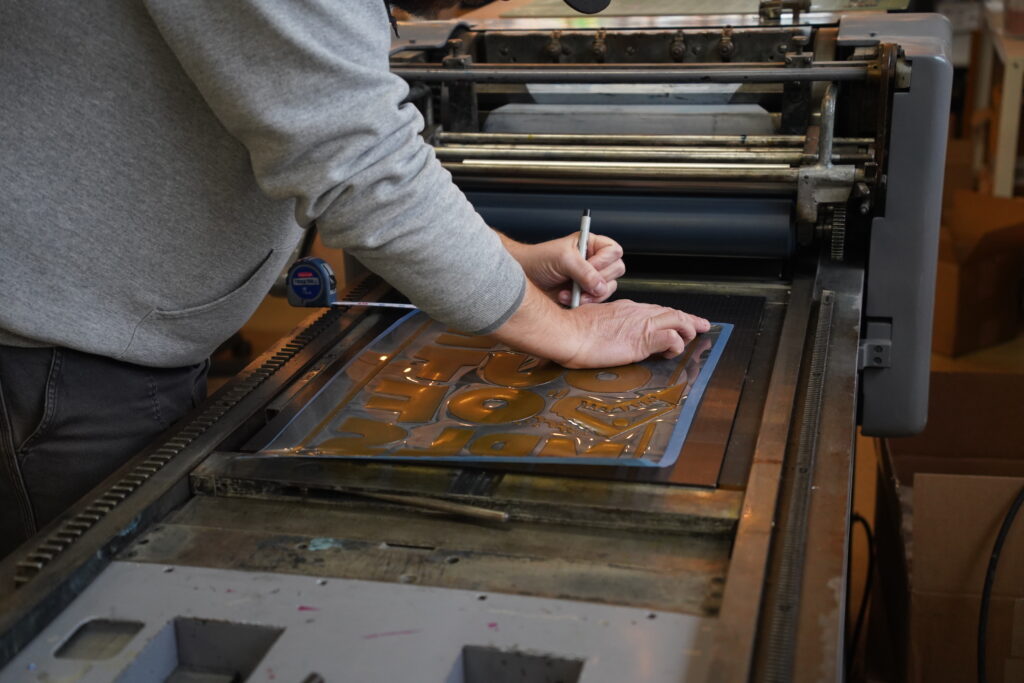
“Even before this federal occupation it was not a good time to be a small business,” said Jane Shannon, the co-owner of Bench Pressed, a letterpress shop in the Seward neighborhood of Minneapolis. “It shouldn’t fall on coffee shops and retail gift stores to keep people in their houses.”
Still, despite losing tens of millions of dollars due to the presence of the federal immigration agents, businesses, neighborhood coalitions, schools and other local organizations grew a volunteer-based system to quietly coordinate food donation and drop off, rent relief and other forms of mutual aid.
Lake Street took the biggest hit in economic loss in January, dropping an estimated $46 million in monthly revenue according to Russ Adams, the director of the Lake Street Council. The street is home to 2,500 businesses and supports 33,000 employees from Somali restaurants, mercados, barber shops, mosques and more.
The immigration surge took away local businesses’ source of income. “They’re scaring workers away,” Adams said. “They’re chasing away your customer base. So how are you gonna pay your monthly rent? The bank loan that you have to repay, and now you can’t make those payments.”
Businesses step up to deliver mutual aid
Ben Mena, the owner of Time Bomb, a vintage toy and collectible shop on East Lake Street, pivoted his business model to accommodate mutual aid needs for the community. Rather than acting as a nostalgic consumerist time machine, Mena said the shop now acts as a mutual aid machine.
“We ended up selling a bunch of [time bomb] t-shirts and raising several thousand dollars,” Mena said. “I think it ended up being somewhere a little north of $5,000.”
Mena said the system he and his wife, Lizzie, created involves ordering bulk t-shirts, selling them individually for $20 and donating $13 from a sale directly to a GoFundMe or neighbor in need.
Elia Read, owner of Shepherd’s Table, a cheese and sandwich shop in the Longfellow neighborhood of Minneapolis, said as a business owner it is not his job to ask questions but to listen and provide help when applicable.
“People can’t leave their houses,” Read said. “So we donate a lot of milk, a lot of eggs, a lot of butter. We do this in informal and formal ways. If somebody comes in and they say that they’re feeding someone, it’s not our job to ask questions.”
Both Time Bomb and Shepherd’s Table encountered Immigration and and Customs Enforcement activity in January only feet away from their businesses. Both times, a single whistle from an observer drew crowds of neighbors. Read and Mena agreed that the incidents were not something to be surprised about, however the escalation from past interactions throughout the city have shifted their views on the urgency of community watch.
“We all went through George Floyd so everybody on Lake Street is still skittish and what I learned [from January] is s–t can get really, really f–king bad really quick,” Mena said. “But also, people come together really quick and do really good things.”
Jane and Andy Shannon launched Bench Pressed in 2011 as a letterpress, producing greeting cards with feisty puns or twists on special events. As the immigration crackdown grew this winter, Jane and Andy began receiving packages from friends across the country full of prints or whistles in order to be sold for direct mutual aid funding.

“Some friends that are in New Mexico have been sending money for rent. Other friends from Colorado were like, ‘We don’t have any money, but can we send you prints and you can sell them, or you can put them for mutual aid, or just let us help you’,” Shannon said.
A bus ride away, Allison Bross’s shop, b. Resale, directly faces the memorial at 26th and Nicollet Avenue, where Alex Pretti was killed by federal agents. To the right of the thrift shop’s entrance are boxes of gas masks, eye goggles, Plan B pills, menstrual products, whistles and informational packets about how to safely encounter ICE agents. Bross said fighting back comes naturally to people who lived through the murder of George Floyd and its aftermath, and that the constant restocking of protesting gear and clothing in the shop’s free bin shows that.
“It almost feels like angels or mystery people,” Bross said. “There’s no names attached to these boxes and although we’ve downsized the space, we have back stocks to keep putting out for months on end.”
The big question: Is this sustainable?
Business and restaurant owners, especially on Lake Street or near cultural corridors, know that the immigration surge has left them in economic peril. In the worst case, some of them may not survive. But in the best scenario, they say, the experience can help create a stronger sense of community that feeds a new business model for their neighborhoods.
“I think folks are trying to channel their rage and their anger into something more positive,” Adams said. “That might be the way to think about how this all mushroomed into what mutual aid is. It’s offering people a ride, accompanying schoolchildren as they just simply walk to their bus stop or being outside the school to delay ICE from showing up.”
In February, mutual aid donations fell dramatically. Some who raised $200,000 in January fluctuated around $2,000 to $3,000 toward the end of February. However, other models arose to fill some of the gap. Events such as print making at Art Price Studio in northeast Minneapolis and rock music shows at First Avenue raised money to specifically go towards organizations that distribute relief to families in need. Post Modern Times on Chicago Avenue is continuing to be a “free restaurant,” shifting its business model to become a non-profit. Likewise, Mena said Timebomb will continue to donate 93% of their merch revenue to local mutual aids indefinitely.
“Every time we draw people into this kind of movement of collective care, you know, I guess the goal would be to get them to stick around a little bit longer,” Bross said. “Get more of them to stick around, knowing that this could actually be a sustainable system, but we all have to participate.”

Small businesses in the city are frustrated because they already struggle to provide benefits such as healthcare or 401(k)s, since companies with fewer than 50 employees are exempt from the Affordable Care Act, according to Jane Shannon. Restaurants feel similar, as bills towards food delivery and labor heightened due to sudden closures and slow business, according to Read. Read said restaurants are facing financial jeopardy in the months following January, and that he expects many restaurant owners to abandon their businesses.
In February, the Minneapolis city council voted to establish a $7 million relief fund to support businesses that have lost and are losing money due to the federal immigration operation. The funding will come from the city’s downtown assets fund which supports costs towards downtown infrastructure such as the Target Center and Minneapolis Convention Center, according to the Minneapolis Foundation.
“In 2026, we’re only gonna save ourselves,” Jane Shannon said. “No one can come in and help us. It’s the government that’s coming against us.”