
Is Yoga Political
By: Sophie Houdek
How do you seek out peace and community at a time when your local community is under attack, and people are scared to leave their homes? How can you find inner peace when you don’t feel safe or protected in your usual environs?
And how does a large corporation respond–how should it respond–to demands from its customers to take a stand at a time of high political tension?
On a frigid Friday in late January, Minnesotans and many local businesses participated in a Day of Truth and Freedom, or “economic blackout,” to bring more attention to the federal government’s immigration enforcement surge. Organizers estimated that 50,000 people took part in a mass protest, demanding the withdrawal of Immigration and Customs Enforcement agents, legal action taken against the ICE agent involved in the death of Renee Good earlier in the month, and the defunding of ICE.
Large corporations, including some based in Minnesota, have faced boycotts in recent years by customers who want to see their own values reflected in corporate policies. In early 2025, Target faced major sales decreases in stores nationwide after the company’s decision to roll back on DEI initiatives due to pressures from the Trump administration. Recently, the company also has faced criticism for not speaking out more strongly against the immigration crackdown. Similarly, Starbucks also has faced a backlash over its pricing, employee relations and charges that it supports Israel financially and discriminates against employees who’ve shown support for Palestine.
Heather Anderson found herself in the middle of one such dispute when she arrived for her normal Sunday morning class at CorePower Yoga in northeast Minneapolis on Feb. 1. Anderson is executive director of the non-profit The Advancing Equity Coalition, which advocates for financial aid from school boards towards young students and their families.
Here is her story.
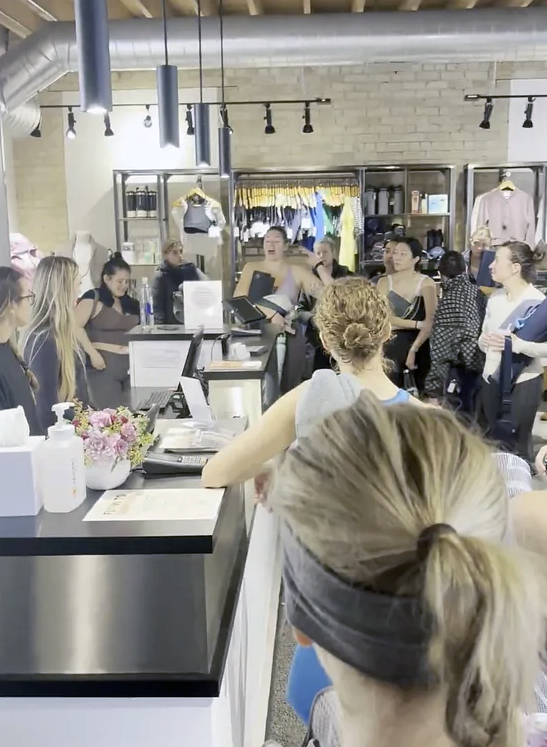
Anderson had been going to classes at CorePower for nearly a decade when she arrived that morning. This time, she said she was greeted by two employees from corporate headquarters in Denver. Anderson said one of them, named Delaney, opened the door for her and told her they had come to discuss any concerns customers had about the presence of ICE in Minneapolis. Anderson said she shared her concerns about the safety of instructors and customers at CorePower Yoga.
When the class was over, Anderson found the lobby of the building filled with customers facing the two corporate employees, who were behind the front desk. Anderson said the corporate employees weren’t responding to questions about the company’s attitude toward ICE activities in Minnesota. Anderson decided to pull out her phone and share her concerns and frustrations.
“When I pulled out my phone I was like, ‘If you are going to stand here and say nothing to us, then I’m going to record you saying nothing.’ ” In the coming days, the video went viral, and Anderson said she thinks she understands why. “Even if you hated it–or if you loved it–you recognized it and could see yourself in it,” she said. The video was likely to upset anyone who came across it, regardless of whether they thought all businesses should respond to the presence of ICE in Minneapolis, or whether they felt it is ridiculous to ask a yoga studio to take any kind of political stance.
The arrival of the two corporate employees may have resulted from conversations in the previous weeks between managers of the Northeast location and corporate.
A former employee of the Northeast location, Maggie Bott, who worked as a studio experience team (SET) member, said employees from the Northeast location were advocating for a sign on the door declaring that ICE wasn’t welcome in order to make customers feel safe and match the actions of other Minneapolis businesses.
Bott said the corporate employees took down a “Keep ICE Out” sign when they arrived at the Northeast studio location. After the confrontation on Feb. 1, Anderson decided to cancel her membership, and she tried to reach someone at corporate headquarters to explain why.
Instead, two days later Anderson said she received a corporate email that her membership had been canceled effective immediately, citing abusive and profane language, creating a threatening environment. When asked about the corporate email Anderson said “What corporate doesn’t know is that I went up to Delaney afterwards and shared this was not personal.” Anderson said she also offered Delaney an opportunity to reach out either over email or coffee for a follow-up conversation. Other customers present at the confrontation posted on social media that they received emails stating their membership had been frozen for 90 days, meaning they wouldn’t be charged but that they couldn’t attend any classes. Bott said at least six instructors also quit after the Sunday morning confrontation.
Reached for comment to corporate in regards to the situation, customer service experts shared a statement that CorePower Yoga doesn’t support the ICE raids that took place in Minneapolis and are obtaining feedback from customers and want to ensure the safety of their customers. The company did not respond to a request for further comment.
Is it inevitable that a large Western corporation marketing a practice rooted in ancient Indian culture will be in conflict with paying customers who feel that their search for peace and physical community is being disrupted? At least some customers expect the corporation to respond, particularly given the claims it makes about its quote “moral compass:” to unite the community with open hearts, inspire real connections, in the spirit of service, to encourage everyone to thrive.
Large corporations like Target have struggled with their own variant of that question. But many other local businesses pushed back against the immigration surge, making donations or collecting money or essential supplies for families that have been affected. So is it inappropriate to question the largest yoga chain in the United States, with 12 locations in Minnesota, to press it to acknowledge and establish precautions for the safety of their employees and customers?
Anderson said ICE activity felt ever-present. “I almost feel like it’s more like fog, because you’re breathing it in all the time,” she said. “We might have a time of normality, but even when that happens, are we not gonna talk about this? Let’s at least acknowledge this.”
What made Anderson’s video go viral was the idea of two white women, like Heather Anderson and Delaney of CorePower, and a group of individuals who were mainly white being confronted with the idea that attacks on minority groups do, in fact, affect them. And that silence is not neutral. Who you are and everything about you is political. Choosing to stay silent is a political choice. It states that you are okay with the actions of ICE in Minneapolis. As it has been said many times before, silence condones violence.
The Trump administration’s decision to send ICE agents who racially profiled Minnesota residents, taking these people off the streets, invading businesses, and homes without valid warrants is the definition of choice in politics. Feeling so distressed and fearful that you conform into silence is political, too. This story at CorePower Yoga is an example of how you choose to respond in such moments. How you spend your money and how you use your voice have power.
“It might not change power,” Anderson said. “But it always changes you.”