
AI: the next big question
‘The world is still figuring it out:’ How University of Minnesota professors are grappling with generative AI
By: Yvette Higgins
One University of Minnesota computer science professor sees artificial intelligence (AI) as a kind of chicken-and-egg scenario.
Joy Upton-Azzam said many people worry that AI will take jobs away from her coding students because it can write code more efficiently. Despite what others think, she is not worried about job security in her field.
Upton-Azzam said generative AI cannot create new ideas. It can only remix existing ideas to create something that seems new. The world still needs computer science students to design new codes.
“It’s like a chicken and egg,” Upton-Azzam said. “We need more chickens to create more eggs.”
Upton-Azzam wants her “chickens” to learn how to code better than AI can, which is why she prohibits them from using AI for assignments. She hopes her students will be the people that create the next AI tool that is better, more ethical, than the last.
Not all professors prohibit AI in their classes. The university’s policy allows professors to choose their own AI policy.
From pedagogy and job security, to climate change and scientific discovery, AI casts a wide net of influence. The tools can tell you how to bake a pie, create a fake photo of a crying activist, discover that marmoset monkeys call each other by name or even be someone’s significant other.

Since OpenAI released ChatGPT in November 2022, followed by competing generative AI softwares like Meta AI and Google Gemini in late 2023, generative AI has only become more accessible and prevalent in daily life.
The 2025 Chegg Global Student Survey polled nearly 12,000 undergraduate students and found that 80% of students worldwide have used generative AI to support their studies and 50% of students would like GenAI tools specifically designed for education purposes.
According to a January Harvard Business Review survey, 60% of business executives surveyed made at least some job cuts in anticipation of AI, and an additional 29% are hiring fewer people. Ninety percent of those same executives said that their organizations are getting either moderate or a great deal of value from AI.
The market for AI isn’t slowing anytime soon. It is estimated that big tech companies will spend over $500 billion globally on AI expansion in 2026, according to investment bank USB.
With AI gaining prevalence in the professional world, professors have to grapple with the tool that is reshaping the world and the classroom.

AI in higher education
In March 2026, the University of Minnesota announced in an email that they appointed a new vice provost, Galin Jones, who will oversee AI education. In addition, the university instigated a new “AI Hub,” which is a group of leaders who will work to create a cohesive AI strategy at the university.
“Artificial intelligence is transforming the way we work, learn and connect. As a land-grant institution, the University’s leadership in this space is more than an opportunity; it is a critical commitment to Minnesota,” the email said.
The College of Science and Engineering also announced its new AI minor in 2026 that is open to students across colleges and will teach students how to use AI tools in their area of expertise.
Colin McFadden, a technology architect for the Liberal Arts Technologies and Innovation Services, described some changes that could happen in the university. He imagined an “AI intensive” requirement for University of Minnesota students, similar to the writing intensive requirement.
“I think it’s great to let faculty make their choices, but also I’m a very student-centric person, and I think it’s irresponsible if we allow students to go through four years at the university and not have the student have the familiarity of how AI intersects with where they’re going in their career journey,” McFadden said.
The University of Minnesota does not yet require AI courses, but other universities have already incorporated it into their curricula. Purdue University instated an “AI working competency” graduation requirement for students in each academic college to learn the AI skills necessary in their discipline.
Ohio State University promised that every student, beginning with the class of 2029, will graduate with AI fluency. The university’s “Unlocking Generative AI” course will teach students how to use AI responsibly and delve into its impact on society.
McFadden works with professors in the College of Liberal Arts to develop AI strategies in their classrooms. He has noticed professors in social sciences are more willing to incorporate AI teaching components than humanities and arts professors.
A February 2026 College Board study found similar results to McFadden’s observations. Fifty-eight percent of humanities professors said they felt very negative about AI while 54% of computer science professors said they felt at least somewhat positive about it.

Professors disagree
Not all professors agree with Upton-Azzam’s policy prohibiting AI in the classroom, and she does not think they should.

“I think professors like our academic freedom,” Upton-Azzam said.
Luis Garrido, a strategic communications professor, teaches his students how to use AI responsibly in his classes. He thinks that the day when we can no longer navigate the professional world without AI is encroaching quickly.
“What choice do I have?” Garrido said. “I worked in advertising, and if I want to stay relevant in this business then this is the reality.”
Garrido wants his students to know how to use AI as a tool rather than a crutch when they enter the workforce.
Walid Sadok, an agronomy professor, said the argument that we have to teach students how to use AI to promote success in the workforce is “somewhere between lazy and cynical.”
Sadok said he worries about AI inhibiting the cognitive development of his students, and he does not want to give in to using it just because it is popular.
He was working with an international student who was working on their thesis, and he noticed that the student’s speaking skills were noticeably diminishing over the course of a few months, but their writing skills were impeccable.
The student admitted that they had been using AI to write their thesis.
Sadok said he thinks AI can be especially detrimental for non-native English speakers, which is one reason he chooses not to allow it. Sadok is not a native English speaker and he may not have been able to learn the language if he had access to tempting technologies.
“If you have such a powerful tool, and you want to write something quickly, and you know how painful it is to write when it’s not your mother tongue, it can be very tempting,” Sadok said.
Sadok said when choosing an AI policy, he considered how he would act if his students were his own kids, and he decided the potential consequences of AI use were too great to allow it in his classroom.
On the other hand, James Anderson, an agronomy professor, allows his students to use AI for brainstorming and statistical analysis.
Agronomy students have to code in order to analyze their data. Anderson said using AI to code is “just a big time-saver.”
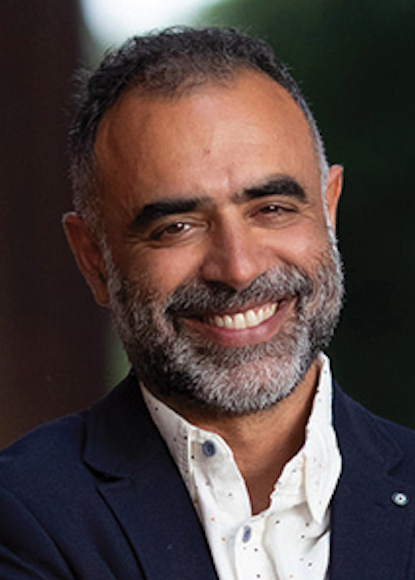

Anderson requires his students to do their own writing, but they can use AI at the beginning and end of a project to brainstorm and edit.
“I think all of us are going to be using it in our professional careers, so I think that it is something that needs to be part of college curriculum,” Anderson said.
Anderson plays with AI on his own every few months and gradually incorporates it into his classes more and more.
One semester, he inserted class notes and lecture videos into Google’s NotebookLM to produce a podcast of two people discussing the course material.
“Why not be listening to your coursework while you’re at the gym working out?” Anderson said. “It’s another way to kind of review course material.”
However, Anderson chose not to show this tool to his students because it stretched the truth. He plans to experiment with the tool again in the fall to see if it has improved.
During the 2024-25 academic year, freshman writing professor Elizabeth Hartman allowed students to use AI tools, such as Grammarly, to edit their essays.
But she changed her mind after she saw these sentences:
“It is his escape from his boring life into one of chaos and anarchy…”
“For him, it is an escape from routine into something unpredictable…”
A student wrote the first sentence, and Grammarly rewrote it into the second sentence. Hartman thought the AI stripped the student’s words of feeling and character.
“It just made me feel a little sad because he was trusting that Grammarly was producing something that was better than what he could do,” Hartman said.
Since that semester, Hartman has not allowed AI tools in her classes. She wants her students to “see themselves as writers and as thinkers who have valuable ideas to offer and have their own writer’s voice,” she said.
Hartman has received positive feedback from students. Some have even thanked her for not allowing them to use AI.

The Student Perspective
Some students expressed concerns about AI depleting their critical thinking skills. Hanuel Jeong-McDonell, a third-year psychology major, said most of her professors allow some AI use, but she chooses not to use it even when professors encourage it because she worries it would diminish her critical thinking skills.
Kate Shelest, a first-year data science major, said even though she sometimes uses AI for her classwork, she thinks that professors should not allow it in their classes.
“I feel like it’s not helping me because it makes my brain lazy,” Shelest said.
Jacob Sommers, a second-year landscape architecture major, said he noticed his professors suddenly allowing AI in their classrooms this semester. He said it almost feels like an insult to be asked to use AI.
“It feels like I am being told I don’t need the skill to do my preferred job,” Sommers said.
Sommers also refuses to use AI because of its impact on the environment. An MIT study found that one ChatGPT response can require as much energy as running a microwave for up to eight minutes.
Other students were more open to using AI in classes. Sameer Gupta, a first-year computer science major, said he likes that his professors teach him how to use AI because he will need to understand it when he enters the workforce.
Gupta said students, not professors, should be able to decide whether or not they want to use AI for their classwork.
LATIS’s McFadden tells professors that whether or not they choose to allow AI in their classes, they need to be honest with their students about what they do not know.
“That can be hard for faculty because obviously you’re used to being the expert,” McFadden said.